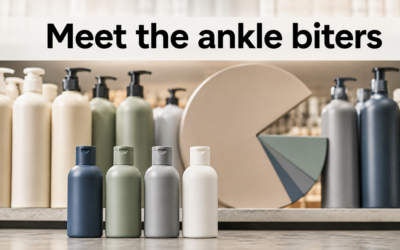



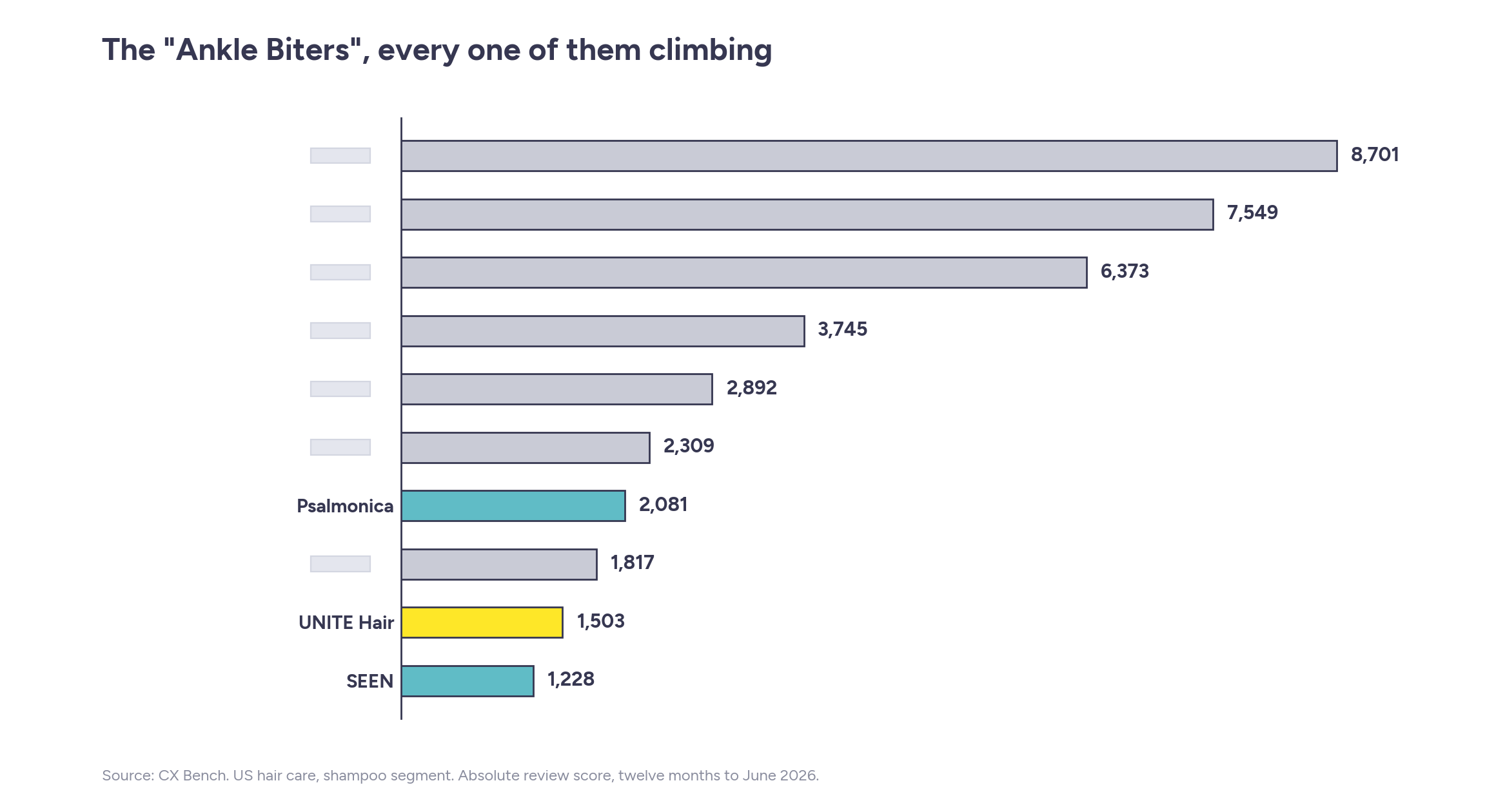
We call them Ankle Biters: small, fast-growing brands nipping at the heels of the category leaders, earning their review scores rather than buying them. Using digital shelf analytics, we screened US shampoo for brands with 100 to 2,000 non-promoted reviews in the twelve months to June 2026, a review rating of 4.5 or better, and rating growth on the prior year. Ten qualified. This is not a top ten. It is ten brands that cleared a bar we set before we looked.
From the outside, shampoo looks settled. That is the most expensive assumption in the category. The global market is worth around USD 37 billion, growing at close to 5% a year. US hair care is worth billions and L’Oreal, Procter & Gamble, Unilever and Kenvue together hold a substantial share. Look closer and the leaders share digital shelf space with hundreds of smaller challengers, and that long tail is where a lot of the momentum sits.
Why digital shelf analytics has to strip out promoted reviews
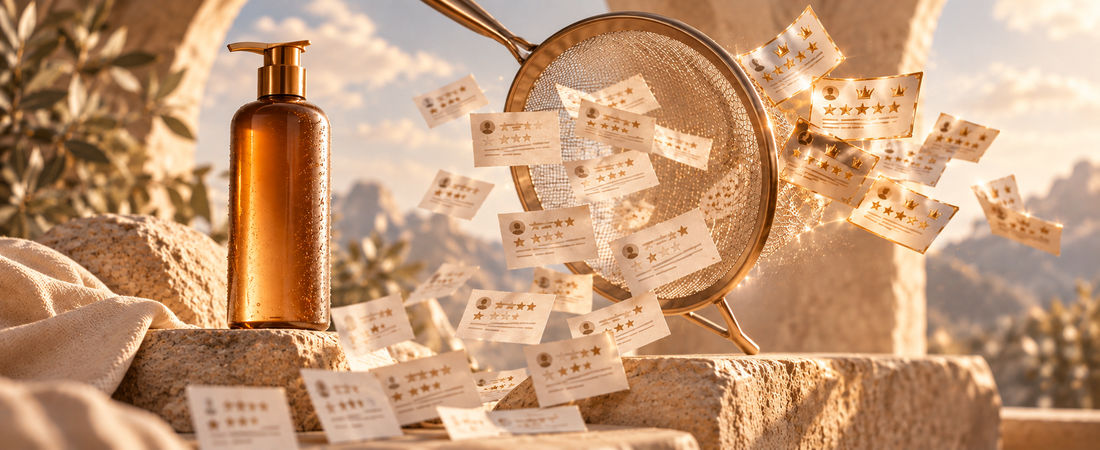
Any digital shelf analytics worth the name has to decide what counts as a review. A rating counts everyone who tapped a star. A review comes from someone who took the time to explain why. Incentivised and syndicated reviews lift a headline number without saying much about the product, so we exclude them. That filter is usually where a good-looking year falls apart. Not here. Everything below is non-promoted only, and UNITE Hair‘s year survives the test intact.
A closer look at one of the ten, UNITE Hair

UNITE Hair is a salon-professional brand, sold through salon distributors rather than grocery. Across US hair care it drew 1,809 non-promoted reviews in the twelve months to June 2026, at a weighted average rating of 4.56. A strong number in any category, and entirely earned. The month-by-month view is where it gets interesting.
What one extraordinary month does to an annual average
June 2026 produced 1,003 non-promoted reviews at a rating of 4.77. That is 55% of the year in a single month. The eleven months before it averaged 73 reviews, with ratings moving between 4.09 and 4.85 and no clear direction.
So the headline 4.56 is not really a description of a year. It is mostly a description of June, sitting under a twelve-month label. That is not a knock on the brand, it is a property of the arithmetic. Brand measurement built on an annual average assumes the year is evenly weighted, and this one is not remotely. Anyone reporting 4.56 should know which month they are actually reporting.
The surge was organic, and that is the hard part
June came in 2,179% above May. It was entirely organic, so no review programme is doing the work here, and it arrived at 4.77 rather than the drop you would expect when a thousand first-time buyers turn up at once. May was 4.45. Winning over that many new people while your rating climbs is genuinely difficult, and UNITE Hair managed it.
What the data cannot say is why. Sudden organic adoption, a viral moment and a distribution expansion all produce this exact shape, and each carries a different read on whether it repeats. If you compete with a brand like this, that is the question worth answering.
Fragrance is the product
Scent and fragrance is the largest driver of conversation by a distance, appearing in 650 reviews. Aerosol and spray formats follow at 342, so the leave-ins and dry shampoos are doing much of the talking, not the shampoo. Then the functional benefits: moisturising at 326 reviews, damage repair at 282, detangling at 250.
Price splits almost evenly, 89 reviews saying it is worth the money against 73 saying it costs too much. For a salon brand at salon prices, near parity is a better result than it looks.
What this means if you are the brand being bitten

The Ankle Biters offer an early read on where expectations are heading. Four questions worth putting to your consumer insights team this week, and if the honest answer to any of them is no, someone smaller than you already knows it:
-
- What is your rating with your single biggest month removed, and how far does it move?
-
- Which of your months is doing the most work, and does your reporting show that?
-
- Can you name the campaign behind your last volume spike, or are you inferring it?
-
- Is your loudest review topic the benefit you are marketing, or a sensory attribute you have never briefed?
Ask it in plain English
Every one of those questions can be typed straight into Presto, in ordinary language. No dashboard training, no query builder, no waiting on an analyst to build you a view. Ask what a launch did to your rating against the range it joined, and it answers from the same data behind this article, in the time it takes to type the question. Year long, and for a fraction of what a single commissioned CPG market research study costs.
The brands watching their challengers today are the ones writing the category rules tomorrow. The rest find out from a share report, long after their shoppers did.
Do you want to know where your brand really stands? Not where it stood last quarter, but where shoppers are putting it right now. That is what CX Bench is for. Book a demo.
Brand data: CX Bench, US hair care, shampoo segment, non-promoted reviews, July 2025 to June 2026 against the prior year.