



We call them Ankle Biters: the small, fast-growing brands nipping at the heels of the category leaders, earning their review scores rather than buying them. The category leaders rarely see them coming, because most tracking studies are not built to look this far down the shelf. We picked ten of them in US shampoo, all of which grew their consumer review ratings this year, most without the media weight of a household name behind them. This is not a top ten. It is ten brands that met a set of criteria we set in advance, and one of them is worth looking at properly.
That brand is SEEN, a dermatologist-developed haircare brand founded by Dr Iris Rubin. It is a clear example of something review data catches and conventional brand monitoring usually misses: a brand whose score is being carried by products that did not exist a year ago.
From the outside, shampoo looks settled. That is the most expensive assumption in the category. The global market is worth around USD 37 billion, growing at close to 5% a year. US hair care is worth billions and L’Oreal, Procter & Gamble, Unilever and Kenvue together hold a substantial share. Look closer and the leaders share digital shelf space with hundreds of smaller challengers, and that long tail is where a lot of the momentum sits.
Why we stripped out the promoted reviews
A rating includes everyone who tapped a star, most of whom never wrote a word. A review comes from someone who took the time to explain why. Incentivised and syndicated reviews lift the headline number without telling you much about the product, so excluding them leaves brands winning on product performance and organic advocacy alone. A harder test, and a more useful one.
Every figure below is non-promoted only.
How we chose “the ten”

We screened US shampoo in CX Bench against three criteria: 100 to 2,000 non-promoted reviews in the twelve months to June 2026, a review rating of 4.5 or better, and rating growth on the prior year and chose ten that cleared all three.
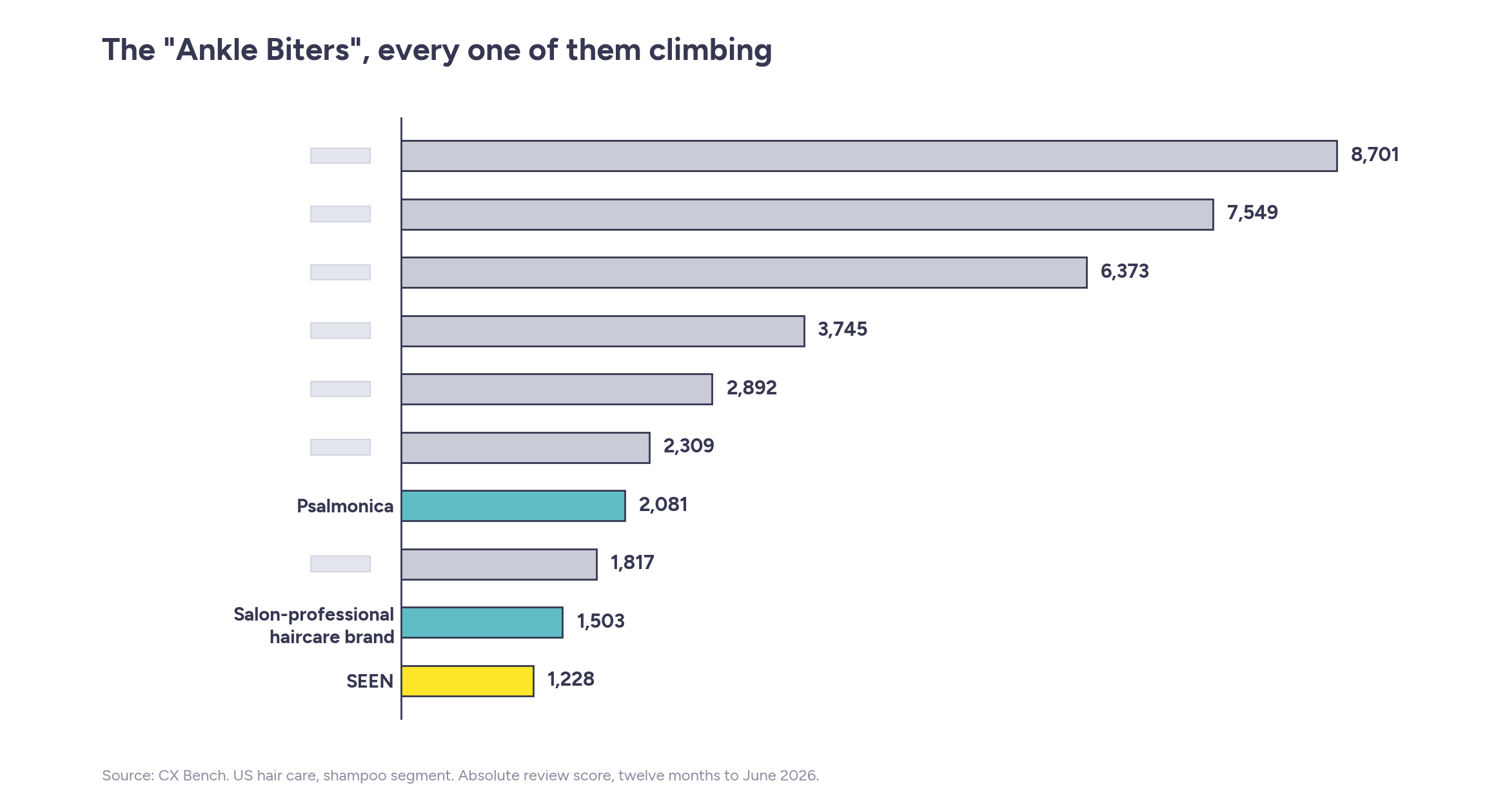
The volume band is deliberate. Below 100 reviews, a handful of enthusiastic shoppers can carry a score. Above 2,000, review programmes tend to be doing more of the work. The 100 to 2,000 range is where the agile competitors and fast-growing niche players sit, and they are less likely to show up in a CPG market research share report. It also means large, well-performing brands are excluded by design, which is the point rather than an oversight.
Eight of the ten brands are hidden. If you would like to know whether yours is one, just ask.
A closer look at one of the ten, SEEN

SEEN’s non-promoted shampoo reviews grew 92.3% year on year, from 142 to 273, at an average review score of 4.5. Nearly doubling an organic review base in a year, without leaning on an incentive programme to do it, is a real result in a category this crowded. The detail is where it gets useful.
Most of the growth is a new range
SEEN launched a Scalp Clarifying franchise during the period, across scented, fragrance-free and multiple size variants. Those new lines account for 167 non-promoted reviews between them, rated 4.77 or better. The longest-standing product in the range, the original scented shampoo, drew 100.
So the growth is not the existing range winning over more shoppers. It is a new range arriving at a high score and taking most of the volume. Both are good news. They are not interchangeable, and only one of them tells you anything about the products already on shelf.
The same portfolio view carries a warning. The Mini Shampoo, Fragrance Free lost 89.7% of its review volume, down to six reviews, and its score fell 1.57 points to 2.83. Six reviews is a thin base, so treat the score as a flag rather than a finding, but a travel size is often where a shopper meets a brand first, and that is an expensive place to disappoint someone.
Fragrance is the most discussed topic in a brand built for sensitivity
Scent and fragrance is by far the most mentioned theme, with 146 mentions, carrying moderate sentiment of 34.9%. For a brand whose fragrance-free variants do much of the volume work, that is a useful tension rather than a contradiction. Shoppers who choose a sensitivity-led product are still forming a strong opinion about how it smells, in both directions.
The highest-sentiment themes sit where the positioning says they should: scalp balancing at 67.5% sentiment across 21 mentions, hair healing and damage repair at 56.2% across 22, and price is worth the value at 30.9% across 20, a reasonable read on a premium price point. These are small bases against the 273 total, so treat them as direction rather than measurement.
The most quoted benefit is the new one. Scalp clarifying draws 78 mentions at 25% sentiment, second only to fragrance on volume, which says the launch has landed as the thing people talk about rather than just the thing they bought.
The clarifying benefit brings its own complaints
Three concern themes cluster together. Dry hair is the third most discussed topic in the whole set at 47 mentions, and its sentiment is only mildly positive at 13.1%, well below every benefit theme. Itchy scalp runs slightly negative at -1.9% across 31 mentions, eczema at -13.3% across 18, and dandruff at -10.9% across 16.
None of these is large on its own. Together they describe a recognisable pattern: a clarifying product that some shoppers find strips more than they wanted, alongside a dermatologist-developed positioning that leads people with active scalp conditions to expect therapeutic relief from a cosmetic product. That gap between what a clinical cue implies and what a formulation delivers shows up in reviews long before it shows up anywhere else, and any brand borrowing dermatological language inherits it.
What SEEN shows that is worth borrowing
Three things, each worth testing against your own reviews.
When a rating moves, check whether the existing range improved or a new range arrived at a higher score, because the two need different responses. Fragrance can be the loudest topic in a category even when the product is bought for something else entirely. And the smallest format in a range can carry the worst score in it, which matters most for the format a shopper is likeliest to try first.
What this means if you are the brand being bitten

The Ankle Biters offer an early read on where expectations are heading. Four questions worth putting to your consumer insights team this week, and if the honest answer to any of them is no, someone smaller than you already knows it:
-
- Do you know how much of your last rating move came from the range you already sell, and how much from a launch arriving at a higher score?
-
- Do you know your most discussed review topic, and whether it is the benefit you are paying to market?
-
- Do you know where your smallest formats sit against your hero SKUs, and how many shoppers are meeting your brand there first?
-
- Do you know what your rating looks like with the promoted and syndicated reviews stripped out, and how far that is from the number you report?
Ask it in plain English
Every one of those questions can be typed straight into Presto, in ordinary language. No dashboard training, no query builder, no waiting on an analyst to build you a view. Ask what a launch did to your rating against the range it joined, and it answers from the same data behind this article, in the time it takes to type the question. Year long, and for a fraction of what a single commissioned CPG market research study costs.
The brands paying attention to their challengers today tend to be the ones setting the agenda tomorrow. The rest find out from a share report, long after their shoppers did.
Do you want to know where your brand really stands? Not where it stood last quarter, but where shoppers are putting it right now. That is what CX Bench is for. Book a demo.
Brand data: CX Bench, US hair care, shampoo segment, non-promoted reviews, July 2025 to June 2026 against the prior year.