

How i-Genie.ai’s consumer intelligence platform unlocks the value of all the insights you never could afford to ask
Every insights leader I talk to knows this meeting. Someone on the brand team has a question: a good one. Is our new competitor’s shampoo actually winning on performance, or just on marketing spend? What are customers saying about the smaller brands eating our shelf space? Is there a segment of our category we’ve written off that’s quietly getting bigger?
The question gets written up. It goes into the research request queue behind the tracker renewal, the concept test, and the two syndicated studies that are already locked into next year’s budget. Someone runs the numbers on what a proper study would cost, compares it to the size of the opportunity nobody has proven exists yet, and the math doesn’t work. The question dies, not because it was a bad question, but because you can’t get a budget approved for a question you can’t yet justify the answer to.
That’s the core dysfunction of the traditional research budget: it demands you prove the value of an insight before you’re allowed to go looking for it. Big, obvious, strategically-sanctioned questions get funded because everyone already agrees they matter. Everything else – the long tail of smaller, stranger, more speculative questions – gets triaged out. And the long tail is exactly where the surprises live, because if the answer were obvious enough to justify a six-figure study in advance, it probably wouldn’t be much of an insight.
Stan Sthanunathan and Paul van Gendt started i-Genie.ai because they watched this happen decades within the most well-funded of brands like Unilever and Coca-Cola. The tools weren’t built to explore. They were built to confirm what a $150K brief had already decided was worth confirming. Everything smaller got left on the table – and “smaller” is doing a lot of work in that sentence, because the questions that never clear the funding bar are often the ones sitting closest to where your next growth line actually comes from. And if this was true for a Unilever, how much worse is it for smaller teams and more limited budgets?
The consumer insights long tail: where the real area under the curve lives
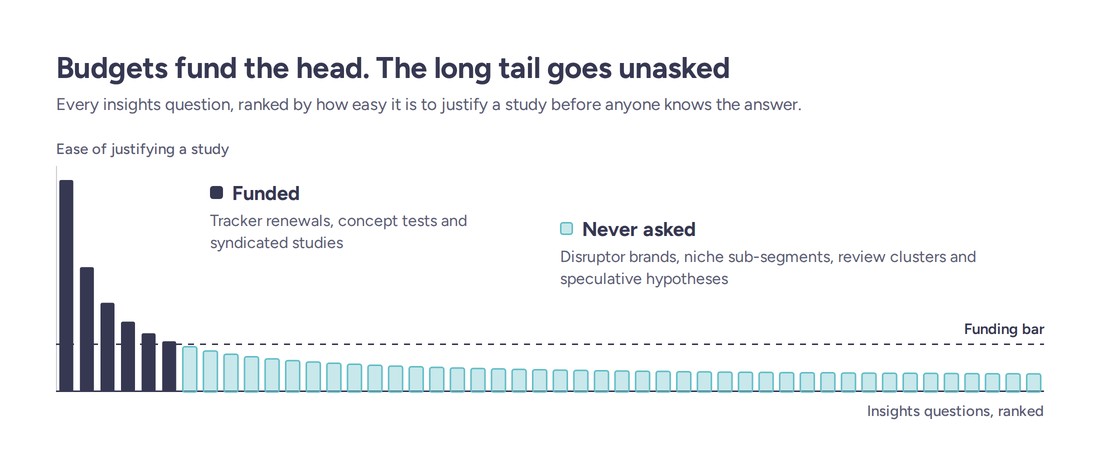
This is a familiar shape if you’ve spent any time in retail, media, or search. Plot anything by volume such as products by sales, songs by plays, queries by frequency, and you get a curve with a thin, tall head of blockbusters and a long, low tail of everything else. The intuitive read is that the head is where the value is: a handful of hits doing most of the work, a long tail of niche items barely worth investing in. That was the logic for decades until the book “The Long Tail: Why The Future Of Business Is Selling Less of More” was published that turned it on its head (pun intended).
The insight that made “the long tail” a business idea worth naming is that the intuition is backwards once the cost of reaching the tail drops to near zero. Sum up the area under that long, low curve (every niche title, every micro-category, every item too small to justify a shelf slot) and it’s often larger than the area under the head. Not one item bigger than any hit, but the tail in aggregate outweighing the blockbusters, because there are so many more points in it. Amazon, Netflix, and Google didn’t win by finding better hits; they won by being the first to profitably serve the whole tail at once.
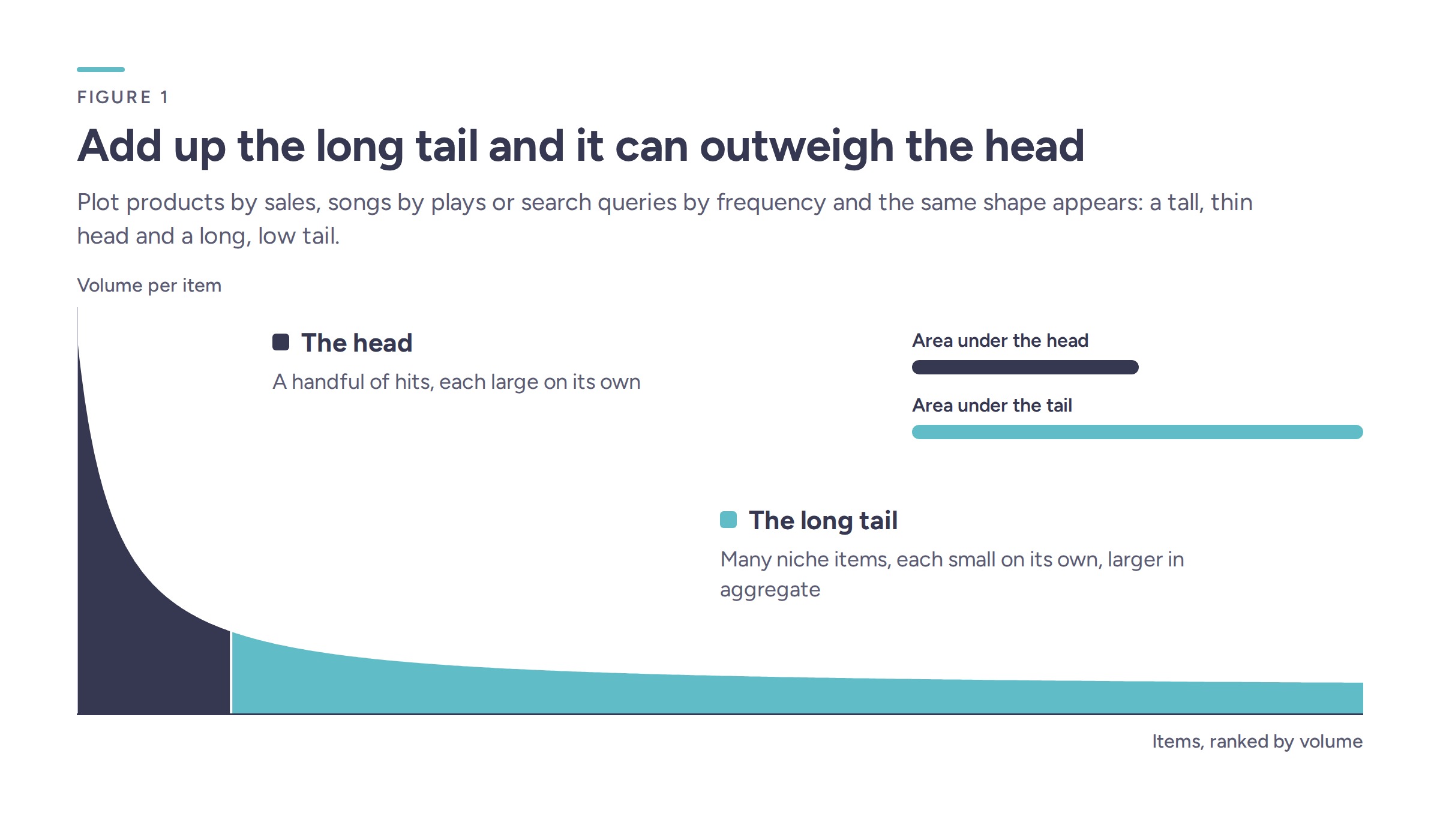 Research budgets are still built on the old shelf-space logic. The “head” – your top competitors, your core segments, the two or three questions everyone already agrees matter – gets the study. The long tail of smaller brands, smaller sub-segments, and smaller hypotheses gets nothing, one question at a time, because no single one of them clears the bar on its own. But the same math applies: add up everything sitting in that tail, every disruptor brand, every niche sub-segment, every “probably nothing” question you never funded, and it could be bigger than the head you’ve been exclusively resourcing. You just can’t see it, because nobody’s measuring the tail at all. There is no measurement of the value of connecting small disparate “tail” insights with “head” opportunities, nor the value of team that is armed with on-demand answers to their initial and follow-up questions, without having to wait for a budgetary process that squashes the very curiosity that is needed in a fast-paced competitive market.
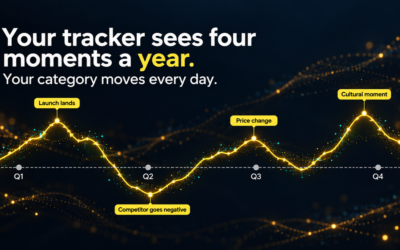
There’s a second wrinkle that matters even more in practice than the aggregate-area argument. A textbook long-tail curve is drawn smooth, a gentle, monotonic decline from head to tail, as if every niche item is roughly as small as its neighbors. In this case, the curve is perceived value, not actual value. Scattered through the tail are spikes: a single sub-segment, a single small brand, a single review cluster that provide a high-value insight that suddenly breaks through starts climbing and compounding in value with every follow-up question. The catch is that a spike is indistinguishable from ordinary tail noise because you have to ask the question to find out its true value.
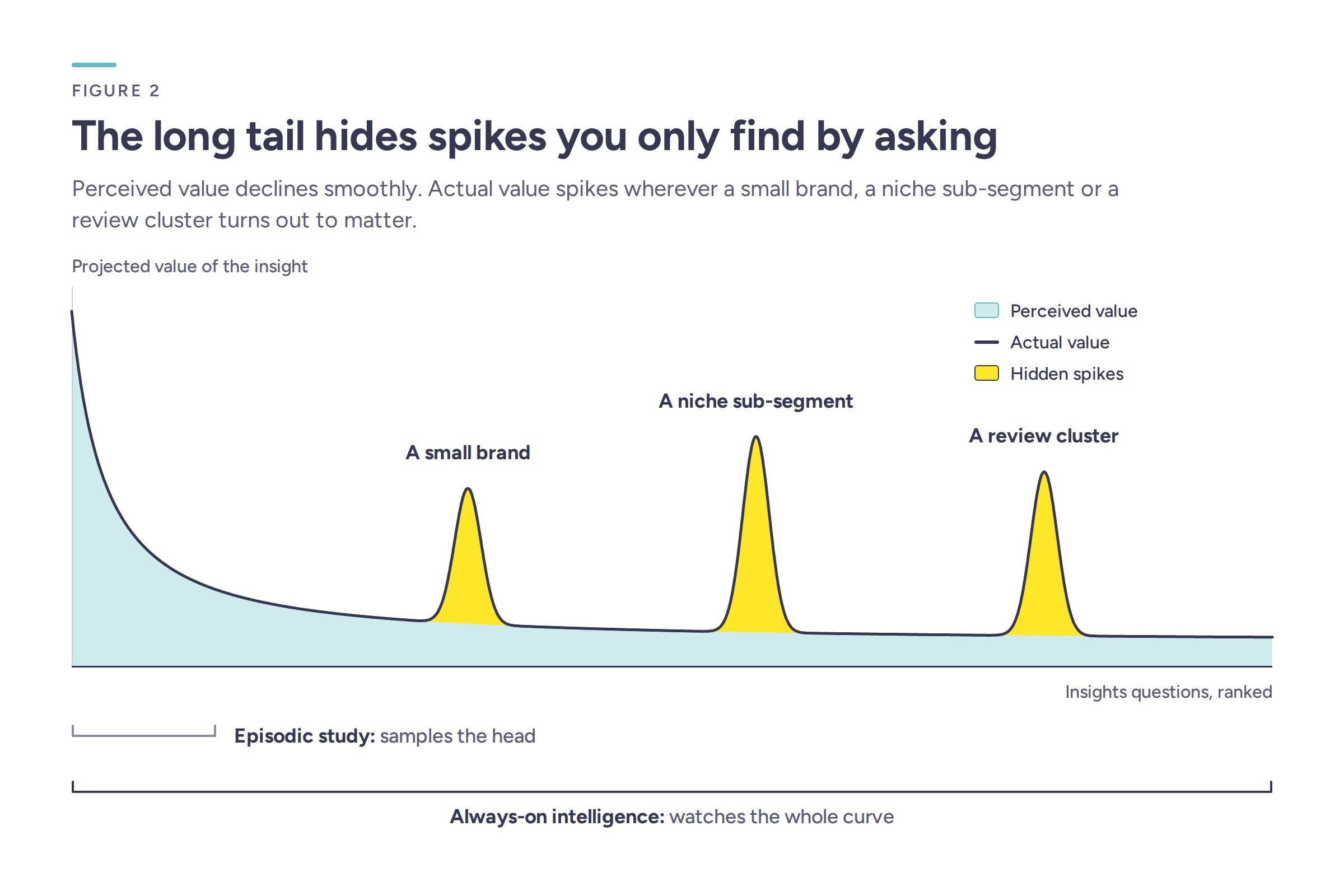
That’s the real argument for always-on intelligence over episodic studies with incremental cost. A study samples the head and maybe one or two tail items you already suspected were worth a look. Always-on, decision-grade intelligence watches the entire tail, all the time, which is the only way to catch a spike while it’s still forming rather than after its already reshaped the category. Every example below is, underneath the specifics, a spike in the tail that i-Genie.ai’s clients caught early because the tail was being watched and queried all along.
When insights question costs approach zero: The case for always-on over ask-and-pay

The fix isn’t a bigger budget. It’s changing what a question costs. When intelligence is always-on and decision-grade, live and reliable enough to act on and not a slide deck that arrives eleven weeks after you needed it, the cost of asking a “small” question drops from a business case to a Tuesday afternoon or an inspired moment after a meeting, or at a conference. You stop rationing curiosity. You start exploring the long tail as a matter of course, and every so often, one of those minor questions turns out to be the reason next year’s plan works. Insights professionals can have a bigger impact in strategic direction.
Four places we see this play out constantly with our clients:
1) The long-tail disruptor brands nobody will fund a study on, until they’re too big to ignore
Every category has a handful of small, fast-growing brands that don’t show up on the radar of a traditional tracker, because trackers are built around the competitive set you already agreed matters and even worse are often stuck with to maintain benchmarking. Nobody approves a dedicated study to watch a brand with a fraction of your distribution. So you find out it’s a real threat the same way everyone else does – after it’s already taken share and the story is written up in a trade publication and your boss asks you why we didn’t see it coming. We didn’t see it because we couldn’t ask.
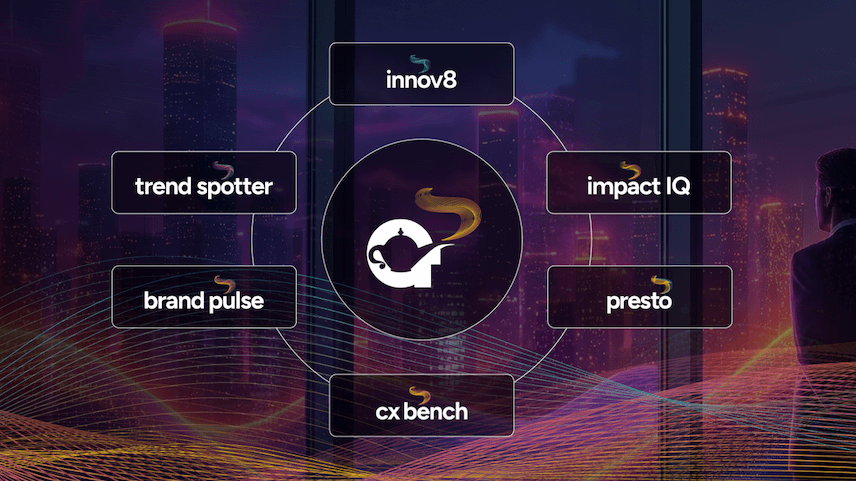
Brand Pulse exists specifically to remove that trade-off. Because it draws on real-world signal – search behavior, reviews, social conversation – across every relevant competitor rather than the three or four you budgeted a survey sample for, watching an emerging brand costs nothing incremental. You’re not choosing between the disruptor and the category leader; you’re watching both, continuously, and letting the data tell you which one is worth a strategic response before your CFO would ever have signed off on finding out. You can see how that plays out for teams already doing it in our Brand Pulse case studies. Most of those brands stay small, flat points in the tail forever, which is fine, that’s what the tail mostly looks like. The point is being positioned to notice the one that isn’t.
2) The product feedback sitting in reviews for brands too small to be “in scope”
Most brand trackers and syndicated panels are built around volume. They follow the players with enough review count and market share to be statistically tidy. That means the products actually gaining traction right now, often precisely because they’re new and disruptive, get missed by design. We wrote recently about a haircare brand whose non-promoted review volume nearly doubled year-over-year, driven almost entirely by a product line that didn’t exist twelve months earlier. A traditional tracker, scoped at the start of the year to “brands that matter,” would never have gone looking for it. There was no line item for “monitor a shampoo brand’s newest sub-range” in anyone’s budget. But that sub-range was the whole story – a textbook spike, invisible to anything that only samples the head.
CX Bench is built to make that kind of question free to ask. Instead of pre-selecting who’s worth watching, it reads the full market of reviews and tells you where the real product-experience movement is happening, including in the corners nobody thought to fund a study on.
3) The long-tail whitespace that “seemed too small” until it was the biggest launch of the year
This is the one I think about most, because it’s the clearest argument against ROI-gating exploratory questions. A multinational hair care brand used CX Bench to dig into negative sentiment in its category expecting to find the usual complaints.
Instead, digging past the noise at the head surfaced something that had been sitting in the data the whole time: a real, underserved need for heat protection formulated specifically for dry hair. It’s a sub-segment that would never have cleared a business case on its own – too narrow, too niche, not worth a dedicated study. It became a best-seller within 30 days of launch, with zero one- or two-star reviews and 4.7 star ratings vs the category average of 4.2 stars. One of their most successful launches in their history. You can read the full case study here.

Nobody would have funded a study called “investigate a hair care sub-segment that is likely too small.” That’s precisely why nobody had found it yet in any survey: it was a spike sitting deep in the tail, indistinguishable from noise until someone was watching closely enough to tell the difference.
4) The long-tail trend no one knew to prepare for until it was too late
We see it all the time… or maybe I should say “we don’t see it all the time”: the insights blind spots that can take market share everywhere you aren’t looking. The ice cream company that could have missed the meteoric rise a chocolate covered frozen fruit that’s “technically” not ice cream or a cross-over brand from candy to ice cream that explodes into the digital consciousness and secondary channels well before it shows up in the sales data. The disruptor brand that proves that hole in the market is an entry point to win a substantial share of the category. If you can’t ask the long-tail of questions, you can’t see the long-tail of disruptors that take 80% of new value creation in a market according to Bain.
But it’s not just the disruptive competitors. Consumer behaviors are changing faster than ever and digital signals are where these are first detected. The micro trend that suddenly drives dramatic shifts in macro behavior. A dairy conglomerate that nearly missed the protein trend. The fashion brand who was tone deaf to size inclusion. It doesn’t have to be this way, even as a slower moving large multinational. Just check out how this skincare giant caught the Collagen trends 6 month earlier with Trendspotter to drive $70m in incremental sales. Or how we helped this large beverage brand cash in on the pro-biotic wave by understanding microsignal connections with one of their existing brands, compressing an innovation cycle and leveraging brand equity to surf the digestive health wave.
Your innovation cycle takes time. Better be able to get the insights you need before your boss asks you why it is already too late.

The AI superpowered insights team is always-on

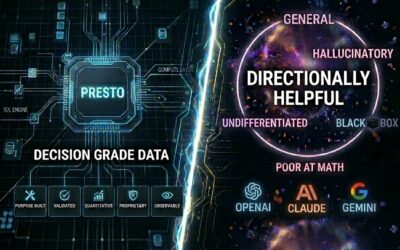
The long tail of consumer insights are powerful, but what we are now seeing at our clients with the adoption of Presto is something exciting and new. Teams that can ask any question no matter how big or small and get answers in seconds using Presto – our agentic consumer insights AI platform. We work with a F1 racing team that wants to understand the value of their brand vs other sports franchises. Well I happen to be a big Knicks fan – Knicks in 5! With Presto I could ask whether the Lakers or Knicks had better fans and why? The answer was a rich analysis of heritage, star power, sentiment, community strength and more. Silly question, but I loved the insights and am better for it.
What happens when all your insights team members and beyond can answer all the small questions? When everybody can better understand every brand, every product, every segment or every trend? Whatever form the next major research project takes, whether you are centralized around a digital consumer intelligence platform like i-Genie.ai or augmenting your existing brand tracking with digital signals everybody will have a richer and more valuable context to make better decisions. You will evolve into a team of superpowered insights professionals because compounding knowledge is what drives exponential growth.

The point isn’t more insights research – it’s fewer questions you leave unasked

You don’t need a bigger insights budget to find your next growth line. You need the ability to ask the questions that never would have survived a funding review in the first place, because the value of those questions is exactly the thing you can’t know until you’ve asked them. The area under the tail can be bigger than the head. The only way to catch it in time is to be watching the whole curve, not just the part your last budget cycle decided was worth watching. That’s one of the bets we’ve built i-Genie.ai around: make decision-grade intelligence always-on, and the long tail stops being the stuff you wish you’d looked into and starts being where you look first.
– Trevor