
Most companies don’t struggle with visibility.
There’s no shortage of dashboards, reports, or metrics to look at.
What’s harder, and often less examined, is whether those metrics are actually helping teams understand what’s happening in time to act on it.
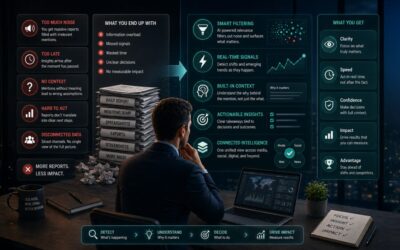
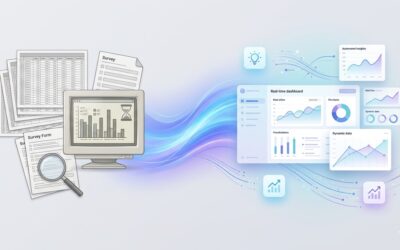
A lot of brand investment is still evaluated through systems that were designed for a slower pace: quarterly surveys, structured panels, and static reporting cycles. They create a sense of clarity, but that clarity often arrives after the moment it was meant to inform.
By the time a traditional brand tracking agency signals a shift in awareness or perception, the underlying change has usually been underway for a while. Competitors may already be benefiting from it. Customers may have already adjusted their preferences.
So the question isn’t whether companies have access to data.
It’s whether the data they rely on reflects how the market actually behaves, or just how it looked a few weeks ago.
Table of contents
-
- TL;DR: Which brand tracking approach actually works
- What to look for in brand tracking companies
- Best brand tracking companies (2026 comparison)
- Why most brand tracking agencies fall short
- How to choose the right approach for your team
- FAQs
TL;DR: Which brand tracking approach actually works
| Approach | Data Source | Speed | Accuracy | Use Case |
| Traditional Surveys | Stated intent | Slow (Weeks) | Lower (Recall Bias) | Legacy Tracking |
| Panel Based Dashboards | Sampled Opinions | Moderate | Moderate | Benchmarking |
| Behavioral Intelligence | Search, Social, Reviews | Real-Time | High | Decision-Making |
| AI Visibility Tracking | AI Generated Outputs | Real-Time | Emerging | Future- Proofing |
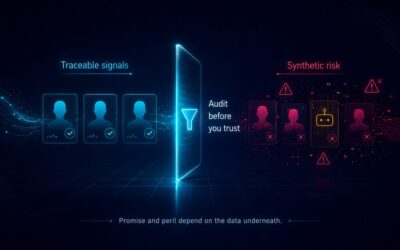
What becomes clear over time is that the difference isn’t just in tooling but also in what kind of signal each approach captures.
Some methods are built to understand what people remember. Others are closer to what people actually do.
And that distinction tends to shape how useful the insight is when decisions need to be made quickly.
What to look for in brand tracking companies

When you start comparing brand tracking companies, most platforms can appear similar on the surface. Interfaces are cleaner, dashboards are faster, and outputs are easier to consume.
But the more important differences sit beneath that layer in how the data is generated and how it behaves over time.
Does it measure behavior or opinions?
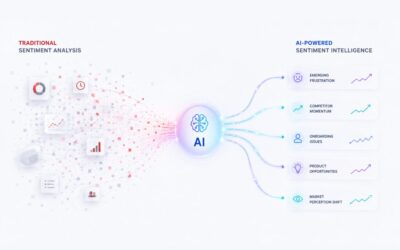
Many solutions still rely heavily on surveys. These can provide structure, but they also introduce limitations:
-
- Participation tends to be low
- Responses are shaped by memory
- Insights arrive with a delay
Behavioral data, on the other hand, reflects actions as they happen — searches, conversations, reviews — and tends to be less filtered.
Is it continuous or periodic?
Markets don’t move in quarters. Perception shifts within days and even hours in response to campaigns, news cycles, product changes, and competitive activity.
A system that updates periodically can still be useful for benchmarking, but it may not capture these movements as they unfold.
Does it help anticipate outcomes, or just describe them?
Some metrics are more closely linked to future behavior than others.
For example, signals like Share of Search tend to move ahead of market share, while others like recall or NPS often reflect what has already happened.
Understanding which signals lead and which follow makes a difference in how they’re used.
Does it scale beyond samples?
Panel-based approaches typically work with limited sample sizes.
Behavioral systems draw from much larger datasets, such as millions of real interactions, which changes both the resolution and reliability of the insight.
For teams focused on consumer behavior analysis, this shift is less about feature comparison and more about the underlying model.
Best brand tracking companies (2026 comparison)
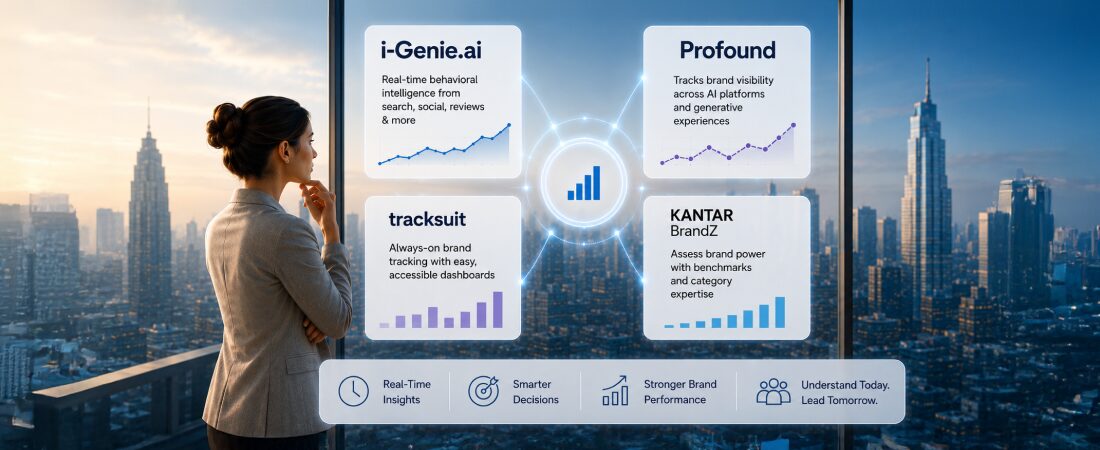
1. i-Genie.ai — Best for real-time behavioral intelligence
Most platforms are still structured around asking consumers what they think.
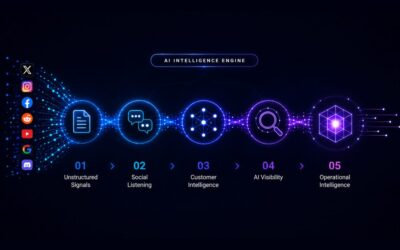
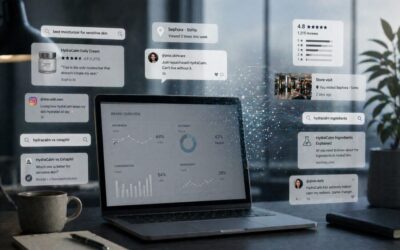
i-Genie.ai approaches the problem differently by working with signals that are already being generated across the market, including search behavior, social conversations, reviews, and video content.
These inputs are continuously synthesized to surface patterns and changes as they emerge, rather than after the fact.
What stands out is less the volume of data, and more how it’s used:
-
- Continuous tracking instead of periodic snapshots
- Signals that tend to move ahead of demand
- Analysis grounded in real interactions rather than responses
This becomes particularly useful when the goal is to understand brand sentiment as it exists in the market, not as it is reported in structured formats.
Best for: Teams that need insight close to decision time, not just reporting cycles.
2. Profound AI — Best for AI visibility tracking
A newer category, but one that is becoming increasingly relevant.
Profound focuses on how brands appear within AI-generated environments, including tools like ChatGPT, Perplexity AI, and Google’s AI-powered search experiences.
As more discovery shifts into these interfaces, visibility is no longer limited to traditional search results.
Understanding whether, and how, a brand appears in these contexts is becoming part of modern brand tracking.
Best for: Teams that are preparing for shifts in AI-driven discovery and recommendation.
3. Tracksuit — Best for accessible always-on dashboards
Tracksuit offers a more accessible entry point into continuous tracking, combining survey-based inputs with a simplified dashboard experience.
It’s easier to implement and navigate compared to traditional research setups, and provides more frequent updates.
At the same time, it still relies on sampled data, which means some of the inherent limitations of surveys remain.
Best for: Mid-market teams looking for a lighter, more usable alternative to legacy research.
4. YouGov BrandIndex — Best for historical benchmarking
YouGov has long been a reference point for brand tracking, particularly for organizations that value consistency over time.
Its strength lies in:
-
- A large, global panel
- Long-term data continuity
- Cross-market comparability
This makes it useful for understanding broad trends and benchmarking performance over extended periods.
Best for: Enterprises focused on long-term brand tracking and comparative analysis.
5. Kantar BrandExpress — Best for strategic depth
Kantar combines traditional research methods with more advanced modeling frameworks.
The output tends to be rich and detailed, often tying brand performance to broader strategic questions.
However, this depth comes with trade-offs in speed and complexity.
Best for: Organizations managing large portfolios that require deep, structured analysis.
6. Otterly.ai — Best for AI narrative monitoring
Otterly focuses on how brands are represented within AI-generated answers, with an emphasis on narrative accuracy and competitive positioning.
As answer engines become a more prominent layer of discovery, this type of monitoring provides an additional lens into brand presence.
Best for: Teams focused on managing how their brand is described and surfaced in AI contexts.
Why most brand tracking agencies falls short
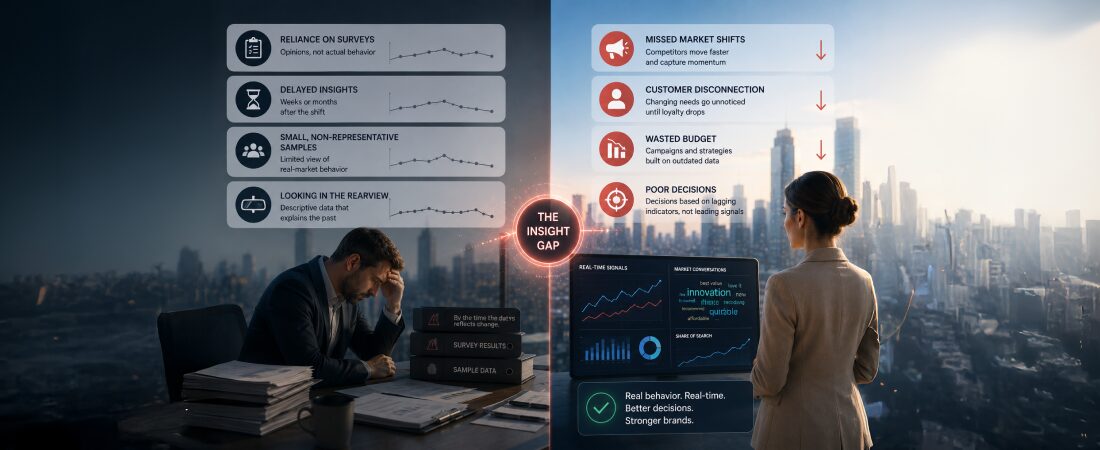
In many cases, the challenge isn’t execution but the structure of the model itself.
A lot of traditional approaches are built around capturing intent. They rely on what people say, recall, or report.
That creates a layer of interpretation between behavior and measurement.
There’s also a timing gap.
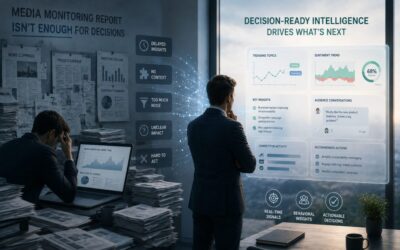
When insights are delivered in reports, they often reflect conditions that have already evolved. The lag isn’t always obvious, but it compounds over time, especially in fast-moving categories.
And finally, there’s the question of usability.
Not all insights translate into decisions. Some remain descriptive, useful for understanding what happened, but less so in determining what to do next.
This is part of why more teams are moving toward systems that combine AI-driven analysis with behavioral data, going beyond just a trend as a way to reduce that distance between observation and action.
How to choose the right approach for your team
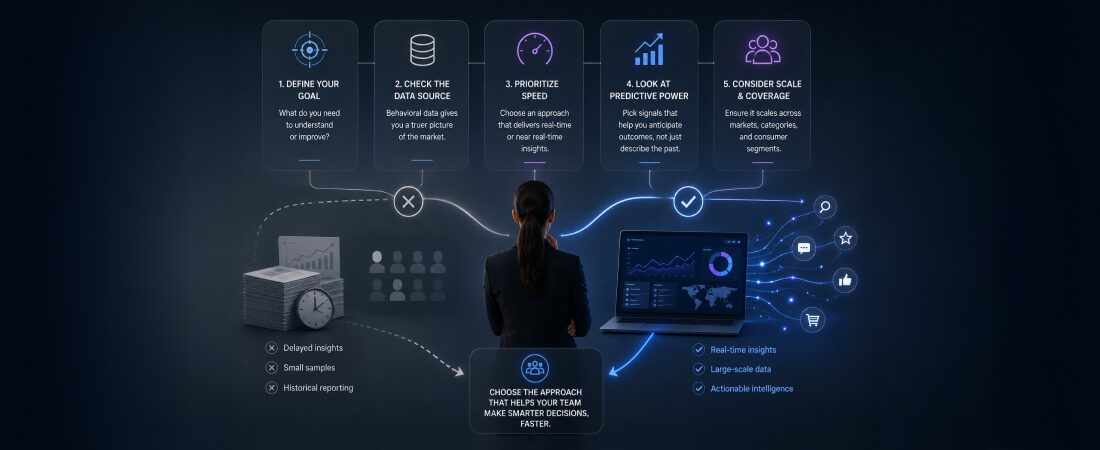
Choosing a brand tracking approach tends to work best when it starts with the decision you’re trying to make.
If the goal is to anticipate movement.
Prioritise behavioral signals:
-
- Share of Search
- Real-time sentiment
- Continuous data streams
If the goal is to understand context.
Layer in conversational analysis:
-
- What people are discussing
- How sentiment is shifting
- What’s driving those changes
If the goal is validation.
Use targeted surveys but more selectively:
-
- To test hypotheses
- To clarify specific questions
- Not as the primary signal source
In practice, the most effective setups combine:
-
- A continuous behavioral layer (for visibility)
- A conversational layer (for interpretation)
- A targeted research layer (for validation)
The order matters.
Brand tracking has always been about making sense of something that is inherently fluid
The importance of this has been highlighted since long time; it is the signals that can help track branding that are gaining precedence now.
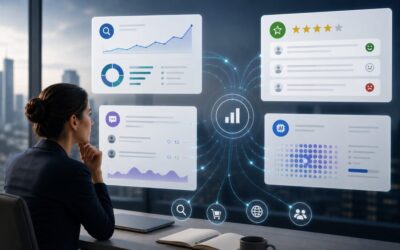
As more of consumer behavior becomes visible, whether across search, conversations, or AI systems, the opportunity is to work with data that reflects those movements as they happen.
For many teams, that shift is less about adopting a new tool and more about rethinking what they consider reliable evidence in the first place.