
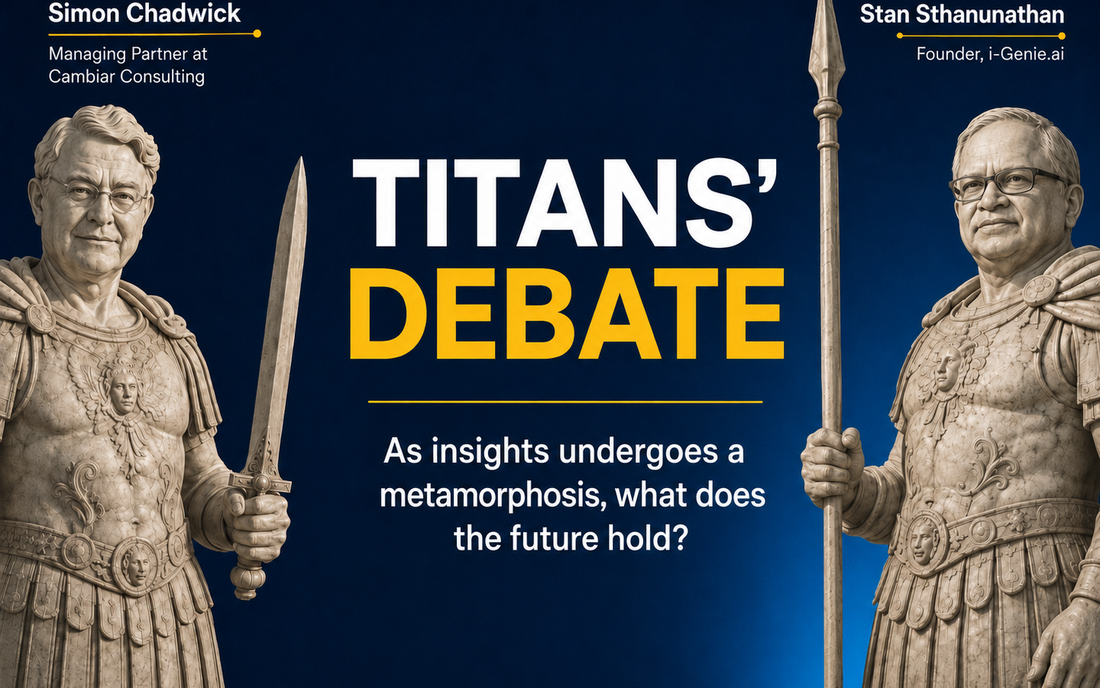
Ten to five on the second afternoon of Esomar Congress 2026 in Valencia, and the auditorium was full. The theme was Metamorphosis, and the programme tested it the way you test an election: two candidates, timed answers, a vote at the end. The format was adversarial. The tone was not.
On one side, Stan Sthanunathan, Founder and Executive Chairman of i-Genie.ai and formerly insights leader at Coca-Cola and Unilever, arguing the era of asking questions is ending. On the other, Simon Chadwick, founder of Cambiar Consulting and former global CEO of NOP World, arguing the survey is still one of the sharpest tools we own. Moderating, Mayke Harkema of SKIM, who noted she had the most at stake: she has to build a career in whichever future wins.
Stan: everybody lies
Stan opened with a book. Everybody Lies, Seth Stephens-Davidowitz’s account of what people confess to a search bar and nobody else. Not some people. Everybody. Being asked changes the answer, and no trap question has fixed that. Then he turned the question on the room: when did you last take a survey yourself? Now ask your friends. The line that landed hardest came later. Did you run a five-point scale before committing to your partner? Of course not. You listened to your heart, because that is how humans work. His verdict: the age of asking is over, and the age of listening and observing has begun.
Simon: the survey has already evolved
Simon’s reply opened with four words. “Let me count the ways.” What followed was a careful case for the defence. Done properly, surveys land inside their margin of error, while bots account for more than half of social posts, fake reviews are common, and algorithms decide what listening hears. His central objection was about definitions: judging research by the rigid question-and-answer survey, he suggested, is like pointing at a horse-drawn buggy and concluding wheels do not work. Modern surveys are conversational, implicit and behavioural. Listening has a blind spot too: it captures the loud and the immediate, while a good survey still reaches the people nobody else hears.
Where they agreed
Both then converged. The prize is not the instrument. It is the so what and the now what. Stan’s case is that AI clears the grunt work and buys back the time. Simon’s is that synthesis, empathy and storytelling turn evidence into impact.
Four things to take back to your team
-
- Treat the say-do gap as structural. It is not a questionnaire problem waiting for a better scale. Reserve asking for what only asking answers, product testing and motivation, not for what people reveal more honestly elsewhere.
- Audit fraud on both sides. Surveys carry fraudulent respondents; listening carries bots, paid posts and fake reviews. Ask any supplier, including us, what they do about it. Review-based benchmarking is only as good as its cleaning layer.
- Ask who is missing from your signal. Organic data over-represents the vocal. Check whether the quiet middle of your category appears in your evidence, and whether you can tell a fad from a trend.
- Move your value to the decision. Nobody is promoted for choosing an instrument. Build continuous measurement that frees the team for the so what and the now what.
That is the real metamorphosis. Not asking against listening, but a profession judged on the decisions it changes. For how the two fit together in practice, read our white paper on augmenting and modernising brand equity tracking with digital signals.